


Residents of New Taipei City’s (新北市) Linkou District (林口) yesterday protested a plan to turn 16 hectares of woodland and parks into an athletes’ village for the 2017 Universiade and clashed verbally with officials at a presentation for the project.
“Call off the meeting,” “Show some respect for Linkou residents,” residents shouted while holding up a giant banner that read: “No to deforestation in Linkou by Taipei City,” interrupting the meeting of Taipei and New Taipei City officials to present the athletes’ village project at Linkou Senior High School yesterday afternoon.
To accommodate the needs of athletes taking part in the Universiade, which will be hosted by the Taipei City Government, an athletes’ village in Linkou is being planned and the dormitories for athletes will later be converted into 3,000 housing units for sale or rent.
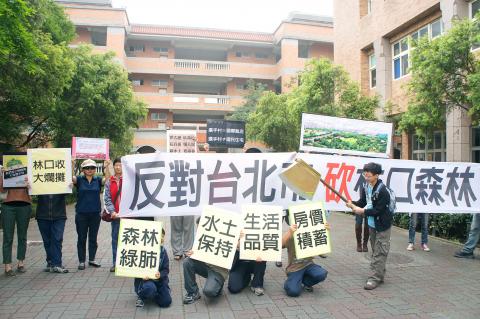
Photo: Lai Hsiao-tung, Taipei Times
The plan met with strong opposition from residents when it was made public last year.
“You know why we’re so upset? Because you never told us about it before you selected the site,” Linkou resident Chu Yu-lin (朱玉麟) shouted at officials sitting in the front.
“A decision that concerns the public should not be made by just a few,” Chu added.
Some residents also challenged the legitimacy of the meeting.
“The Taipei City Government notified the New Taipei City Government about the meeting last week and it was even later when we residents received notice. Some people in some neighborhoods learned about it on Thursday and I never even got the news,” said Hsu Chu-feng (許主峰), a teacher at Linkou Community College.
“I suspect this is a trick that the government played so that those affected wouldn’t be able to make it to the meeting to express their opposition,” Hsu said.
As officials insisted on continuing the meeting, most opponents to the plan decided to withdraw from the meeting, leaving about two-thirds of the seats empty.
“It’s ridiculous that we have to sacrifice 16 hectares of woodland with rich biodiversity and parks to cater to the needs of a sports event that only lasts two weeks,” Action Alliance for Saving Woodlands in Linkou convener Wang Chen-nai (王貞乃) said.
“It took more than 40 years for threes to grow on those lands, and five of the trees have been placed on the protected trees list because of their age by the [New Taipei City] Department of Agriculture. We are strongly opposed to the destruction of such a rare area in the Taipei metropolitan region.”
Chu said he was worried that the athletes’ village would destroy the quality of life in Linkou.
“Although most newly completed housing complexes are still empty, traffic problems have already appeared. The problem would only get worse because the government plans to turn the athletes’ dormitories into about 3,000 housing units for sale or for rent. Don’t forget that in Gueishan Township (龜山), Taoyuan County, on the other side of the Linkou Plateau, the government is also planning to build more social housing complexes,” Chu said.
“In addition, we’re already experiencing a water shortage, I don’t know how they’re going to supply enough water for tens of thousands of more people,” Chu added.
In a press release, the New Taipei City Department of Urban and Rural Development said the Taipei City Government has already agreed to preserve the Linkou Sports Park, adding that the New Taipei City Government would continue to negotiate with Taipei on the project’s impacts on traffic and ecology.

UPGRADE: The Kang Ding-class frigate is replacing its Chaparall missiles with Tien Chien II and Hua Yang VLS, which would provide it with long-range, 360° air defense Taiwan plans to produce 1,200 to 1,376 Hai Chien II missiles (海劍二, Sea Sword II) — also known as TC-2N — to serve as the standard air defense system of the navy’s surface combatant fleet, a source said yesterday. Last week, the Hai Chien II, the naval version of the Tien Kung II missile (天劍二, Sky Sword II), completed a live-fire test in waters off the National Chungshan Institute of Science and Technology’s Jiupeng facility (九鵬) in Pingtung County’s Manjhou Township (滿州). The MIM72 Chaparral and other dated air defense missiles that currently arm Taiwanese ships have inadequate range to combat Chinese

REASONS FOR TRAVEL: An assistant professor said that proposed amendments to penalize drivers if they used drugs overseas would not deter people from traveling People who operate a motor vehicle under the influence of marijuana would have their driver’s license revoked, even if they used the substance while overseas, the Ministry of Transportation and Communications said yesterday, citing proposed amendments to the Road Traffic Management and Penalty Act (道路交通管理處罰條例). The amendments would also authorize the government to revoke the licenses of people determined to have used Category 1 or Category 2 narcotics, even if they were not operating a vehicle while under the influence of drugs, as well as ban them from taking the license test for three years, the ministry said. People aged 18 or

HEAVY WEATHER: Typhoon Jangmi is due to crash straight into the Ryukyus as airlines look to shift flights to larger aircraft or cancel flights to Okinawa entirely Taiwan’s international air carriers announced flight adjustments over the weekend as Typhoon Jangmi is forecast to hit the Ryukyu Islands today and tomorrow. The Central Weather Administration (CWA) upgraded Jangmi from a tropical storm to a typhoon at 8am yesterday, with the eye located 580km south of Naha city. It was moving north at 19kph. Today, China Airlines’ CI-120, CI-121, CI-122 and CI-123 flights between Taoyuan and Naha, Okinawa, have been canceled as well as CI-132 and CI-133 between Kaohsiung and Naha. EVA Air’s BR-112, BR-113, BR-186 and BR-185 flights between Taoyuan and Naha are also canceled. Low-cost carrier Tigerair Taiwan canceled IT-230,
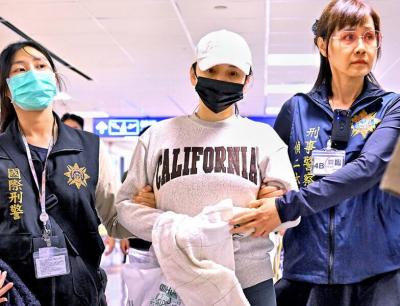
Johanne Liou (劉喬安), a Taiwanese woman who shot to unwanted fame during the Sunflower movement protests in 2014, returned to Taiwan last night after being deported from the US. She is to stand trial in Taiwan for charges involving embezzlement, fraud and drug crimes. The Criminal Investigation Bureau (CIB) said it took her into custody at Taiwan Taoyuan International Airport and would first question her before transferring her to the New Taipei District Prosecutors’ Office. She was arrested upon disembarking a flight from San Francisco that landed shortly before 7pm. Liou absconded to the US in 2019 after jumping bail


 RSS
RSS